Kubernetes vs. HashiCorp Nomad: A Comprehensive Comparison
- Sarvesh Mishra
- DevOps, Container Orchestration
- 23 Nov, 2025
In the world of modern application deployment, container orchestration has become a critical component. As organizations scale their infrastructure, the need to manage, deploy, and scale applications efficiently has led to the rise of powerful orchestration tools. Two of the most prominent names in this space are Kubernetes and HashiCorp Nomad.
While both tools aim to automate the deployment, scaling, and management of containerized applications, they approach the problem with different philosophies and architectures. This article provides a comprehensive comparison to help you decide which tool best fits your needs.
Section 1: Overview of Each Tool
Kubernetes
History and Background: Kubernetes, often abbreviated as K8s, was originally developed by Google based on their internal cluster management system, Borg. It was open-sourced in 2014 and is now maintained by the Cloud Native Computing Foundation (CNCF).
Core Architecture: Kubernetes is a robust, feature-rich platform designed for container orchestration. Its architecture consists of a control plane and worker nodes. Key components include:
- Nodes: The machines (virtual or physical) that run the applications.
- Pods: The smallest deployable units created and managed by Kubernetes, which can contain one or more containers.
- Services: An abstract way to expose an application running on a set of Pods as a network service.
Adoption: Kubernetes has become the de facto standard for container orchestration, with widespread adoption across the industry, from startups to Fortune 500 companies.
HashiCorp Nomad
History and Background: Nomad was developed by HashiCorp and released in 2015. It is designed to be a simple, flexible, and easy-to-use orchestrator that integrates seamlessly with other HashiCorp tools like Consul and Vault.
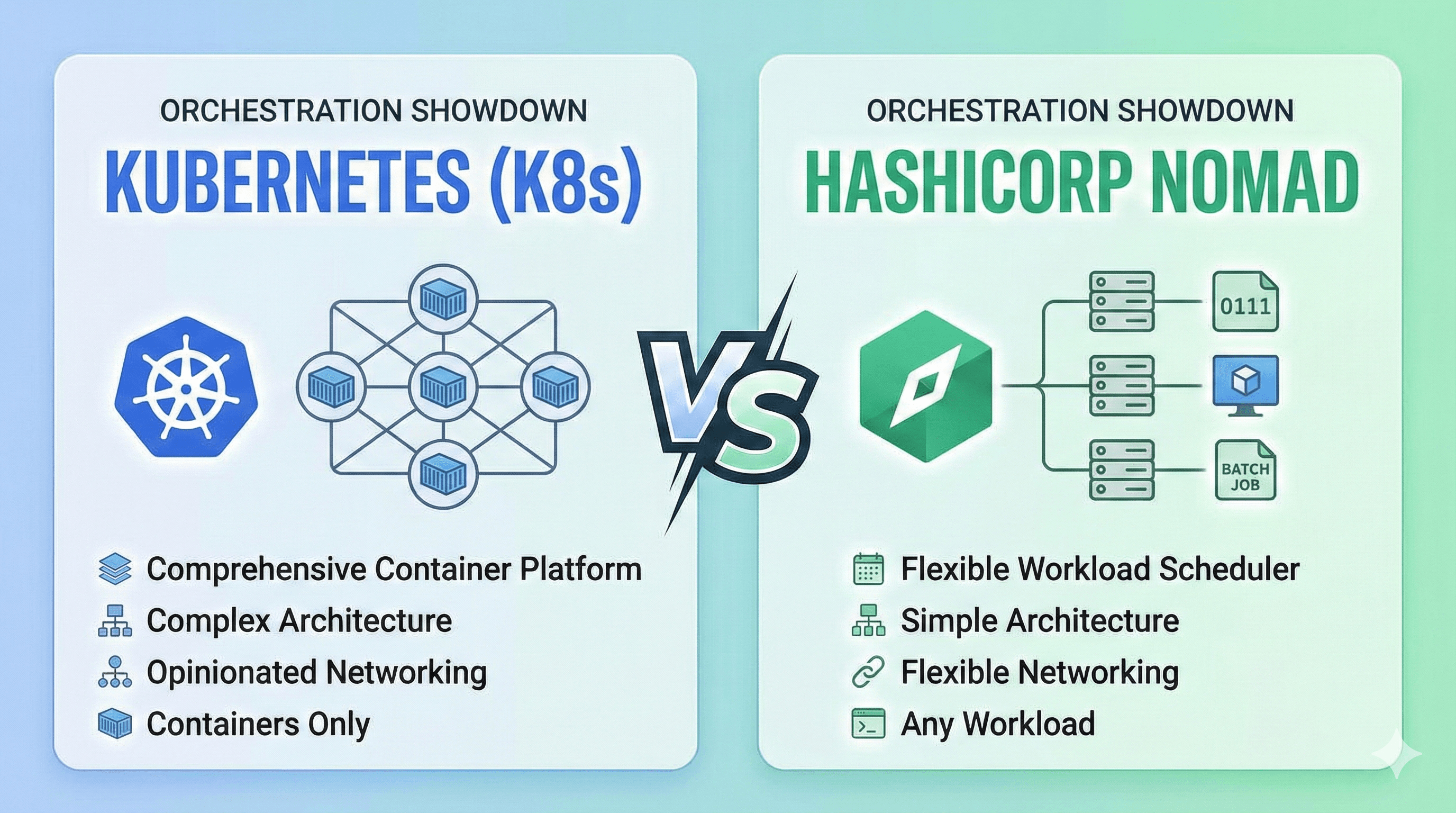
Core Architecture: Nomad focuses on simplicity. It runs as a single binary that can act as both a client and a server. Unlike Kubernetes, which focuses primarily on containers, Nomad is a general-purpose scheduler that can manage non-containerized applications, virtual machines, and batch jobs alongside Docker containers.
Adoption: While not as ubiquitous as Kubernetes, Nomad has a loyal following and is used by major organizations like Roblox, Cloudflare, and Pandora, particularly those who value simplicity and operational ease.
Section 2: Use Cases
Kubernetes Use Cases
- Large-scale Microservices: Kubernetes excels in managing complex microservices architectures with hundreds or thousands of services.
- Stateful Applications: With robust storage orchestration, K8s is suitable for running databases and other stateful workloads.
- Multi-Cloud & Hybrid Cloud: Its consistent API allows for deployment across various cloud providers and on-premise data centers.
- Complex CI/CD: Ideally suited for environments requiring intricate continuous integration and deployment pipelines.
HashiCorp Nomad Use Cases
- Simple Scheduling: Perfect for teams that need to schedule batch jobs, long-running services, or cron jobs without the overhead of K8s.
- Mixed Workloads: Unique ability to orchestrate legacy applications (Java JARs, static binaries) alongside Docker containers.
- Fast Deployment: Ideal for companies that need to get up and running quickly with minimal operational complexity.
- HashiCorp Ecosystem: Best for organizations already heavily invested in Consul for service mesh/discovery and Vault for secrets management.
Section 3: Consumer Base
Target Audience:
- Kubernetes: Generally targets larger engineering teams with dedicated DevOps resources. It requires a significant investment in learning and maintenance but offers unparalleled power and configurability.
- Nomad: Appeals to smaller to medium-sized teams, or large enterprises that want to reduce operational complexity. It is favored by platform teams that want to build a "Golden Path" without managing the complexity of Kubernetes clusters.
Case Studies:
- Kubernetes: Used by companies like Spotify and Airbnb to manage massive scale. Challenges often include the "complexity tax" where managing the cluster itself becomes a full-time job.
- Nomad: Used by Roblox to schedule containerized and non-containerized workloads at a massive scale. The challenge addressed was the need for a unified scheduler that didn't force a complete rewrite of legacy applications into containers immediately.
Section 4: When to Switch from One to Another
Moving to Kubernetes
You might consider switching to Kubernetes if:
- You need a vast ecosystem of third-party tools (Helm charts, Operators).
- Your team is growing, and you need the granular control and standardization K8s provides.
- You are running purely containerized, cloud-native applications.
Moving to Nomad
You might consider switching to Nomad if:
- Kubernetes complexity is slowing down your development cycles.
- You need to manage legacy applications that are difficult to containerize.
- You want a single binary deployment that is easy to upgrade and manage.
- You are experiencing resource overhead issues with K8s control planes.
Section 5: Benefits and Limitations
Kubernetes
Benefits:
- Rich Ecosystem: Thousands of integrations, tools, and managed services (EKS, GKE, AKS).
- Community Support: Massive community means you can find a solution to almost any problem.
- Standardization: Becoming the "operating system" of the cloud.
Limitations:
- Steep Learning Curve: Concepts like Pods, Ingress, PV/PVCs, and RBAC take time to master.
- Complexity: Setting up and maintaining a production-grade cluster "the hard way" is difficult.
HashiCorp Nomad
Benefits:
- Simplicity: Single binary, easy to understand job specifications (HCL).
- Flexibility: Runs containers, binaries, Java, and more.
- Lightweight: Low resource footprint compared to K8s.
Limitations:
- Smaller Ecosystem: Fewer third-party tools and Helm-like package managers.
- Feature Parity: Some advanced features found in K8s (like advanced networking or autoscaling nuances) might require more manual setup or integration with Consul.
Comparison Video
For a visual breakdown of the differences, check out this excellent comparison by DevOps Directive:
Conclusion
Choosing between Kubernetes and HashiCorp Nomad isn't about finding the "best" tool, but finding the right tool for your specific constraints and goals.
- Choose Kubernetes if you want the industry standard, have a team dedicated to platform engineering, and are building complex, cloud-native microservices.
- Choose HashiCorp Nomad if you value simplicity, need to run mixed workloads (legacy + containers), and want to minimize operational overhead.
Before making a decision, evaluate your team's expertise, your application requirements, and your long-term infrastructure roadmap.
Resources:
Let's Connect
We’d love to hear your experiences! Have you used Kubernetes or Nomad? Which one do you prefer and why? Share your thoughts in the comments below.